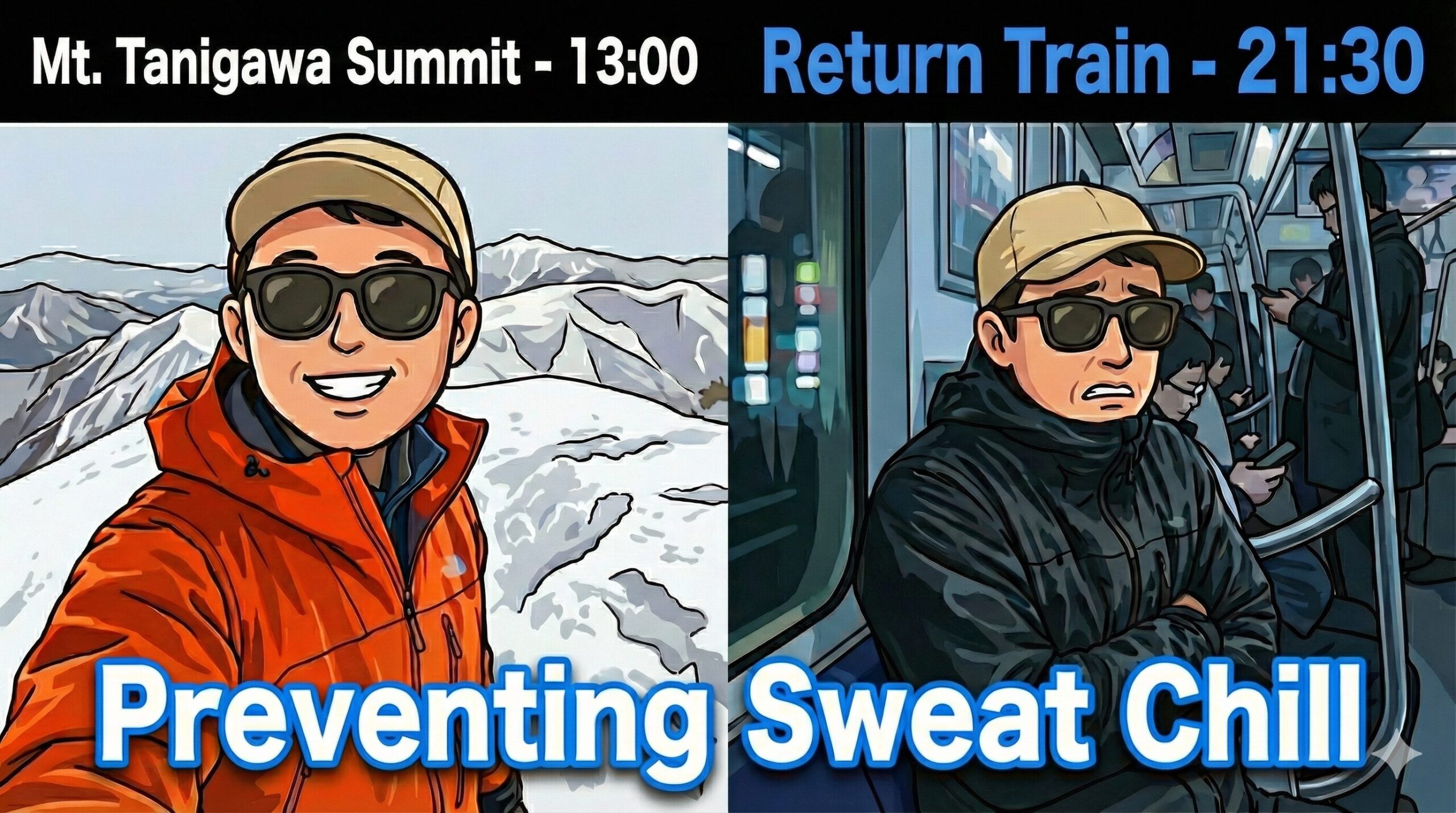
The most critical error of my recent winter ascent did not occur on the summit, but after the descent. The cause: forgetting a dry change of clothes. The result: being trapped in a freezing “mobile freezer” for four hours post-climb.
To fund my future Everest expedition, I sold my car. My entire approach relies strictly on public transportation. This means there is no heated private space waiting for me at the trailhead.
My base layer (heavyweight synthetic) had absorbed a massive amount of sweat trapped inside my hardshell. The moment I stopped moving, physics bared its fangs. The rapid drying process unique to synthetic fibers generated intense evaporative cooling, mercilessly stripping away my core body temperature from the inside out.
From the freezing ambient temperature of the Tanigawadake Ropeway Station to Jomo-Kogen Station, then standing on the drafty deck of a crowded Shinkansen, and finally the endless transit back to my home base.
Four hours of forced immobility while wearing a wet base layer—absolute despair. Had this been the return route to a Himalayan Base Camp, I would undoubtedly be dead.
The Illusion of the Hardshell
Why did I sweat so profusely? The root cause was fear, stemming from my lack of winter mountaineering experience.
Despite my body overheating during a steep, windless, and clear ascent, my fear of getting wet from the snow prevented me from taking off my low-breathability hardshell. I treated it as an absolute suit of armor.
Veteran alpinists are not simply immune to the cold. They fear sweat far more than they fear snow, possessing the technical discipline and experience to perfectly manage their layering.
The Sweat Evacuation Protocol
From this near-miss at an altitude of 0 meters, my equipment and behavioral protocols have been completely rewritten.
Protocol 1: Proactive Thermoregulation
Before relying on gear, change the behavior. Stop before you start sweating, open the ventilation zips, and shed the hardshell without hesitation. Micro-managing body temperature is the absolute core skill of winter survival.
Protocol 2: Mechanical Sweat Evacuation
That day, my lower body was perfectly protected from the extreme cold. The hydrophobic mesh underwear worn beneath my pants created a physical “dead space” between my skin and the wet garments, forcibly expelling sweat outward.
Looking strange is utterly meaningless in the face of survival probability. I am immediately implementing this system for my upper body as well.
To prevent the rapid evaporative cooling of synthetic fibers, I am switching my base layer material to Merino wool.
During my summer traverses, I perfectly utilized its moisture-regulating and insulating properties—its gradual drying rate that prevents rapid cooling. Failing to deploy this proven system in the harshest winter environment was a glaring logical error.
Tear the sweat away from the skin with hydrophobic mesh, and dry it slowly while retaining heat with Merino wool. This is the ultimate layering system I have concluded upon.
The price for forgetting a change of clothes was the hell of a 4-hour freezing transit. However, in the Death Zone of Everest 10 years from now, this exact logistics error would equal instant death.
This failure, and the reinvestment in gear, was an incredibly cheap tuition fee to learn how to survive in extreme environments.



コメント