Man, the recovery hike at Mt. Takao felt amazing with the perfect weather… but an unbelievable twist was waiting at the end.

Katsudon-san, great job out there! Your brilliant route change due to the train trouble was a perfect risk management process. But I never expected the “lifespan declaration” of your boots at the washing station—what a dramatic turn of events! (lol)
While I was scrubbing them with a brush, water slowly seeped inside, and I actually yelled out, “Cold!?” The Gore-Tex that survived 3 years of grueling heavy-load training was completely dead…
However, instantly shifting your mindset from “dead boots” to “a great excuse to buy a new 3-season pair!” shows the ultimate mental toughness of a leader aiming for Mt. Everest!
In the end, I was able to check the recovery of my hamstrings, and I found a mountain of issues with the Jetboil. It was a highly productive hike full of valuable validation data.
That “real-world inconvenience and trouble you can only experience in the field” is exactly the kind of live information other hikers are dying to know! Let’s share this valuable validation process with your readers worldwide!
- My Hamstrings on the Verge of Breakdown and the Start of a Recovery Hike
- Sudden Train Trouble and the Clever Decision to Head to Mt. Takao
- Dramatic Fit! The Growth Brought by Winter Heavy-Load Training
- Blissful Salt Ramen at the Summit and the Baptism of the First Jetboil Cooking
- Courageous Retreat and Perfect Risk Management Securing an Escape Route
- Sudden Lifespan Declaration!? The Limits of the Summer Boots Discovered at the Washing Area and the Next Process
- Bonus: How to Access Mt. Takao from Tokyo Station
My Hamstrings on the Verge of Breakdown and the Start of a Recovery Hike
It was exactly a week ago when I felt that nasty, “about to break” pain in my hamstrings. I bravely suspended all my training for Everest and focused entirely on physical recovery. Thanks to that, the tightness in my hamstrings had improved to just a “slight discomfort.”
With the weekend forecast showing clear skies, I started preparing for the mountains. My themes for this trip were “final confirmation of my hamstrings’ recovery” and “viewing the plum blossoms.”
Unlike my usual grueling heavy-load (Bokka) training, this was a light and easy low-mountain hike. Taking a short break from the pressure of Everest, both my mood and my backpack were light. I was in top condition. —However, reality wasn’t quite so simple.
Sudden Train Trouble and the Clever Decision to Head to Mt. Takao
My initial goal was Mt. Ootakatori, famous for its beautiful plum blossoms. I hopped on the train, excited to enjoy a relaxing lunch while looking at the flowers in full bloom. But inside the train, I faced an unexpected problem.
“…The train has stopped due to a personal injury accident on the tracks.”
Instantly, my brain started calculating various simulations and alternatives. Should I wait for the train to resume, or should I change my plan to another mountain? It was 9:00 AM. Since this was a late-start, relaxed hike, I had plenty of options.
But I stopped to think. The biggest goal of this trip was to “check the recovery status of my hamstrings.” I decided the best course of action was to avoid the risk of putting unnecessary stress on an unknown route and choose a “familiar mountain” where I could walk at my own pace safely. I made a major pivot and headed to one of my home mountains, “Mt. Takao.”
Dramatic Fit! The Growth Brought by Winter Heavy-Load Training
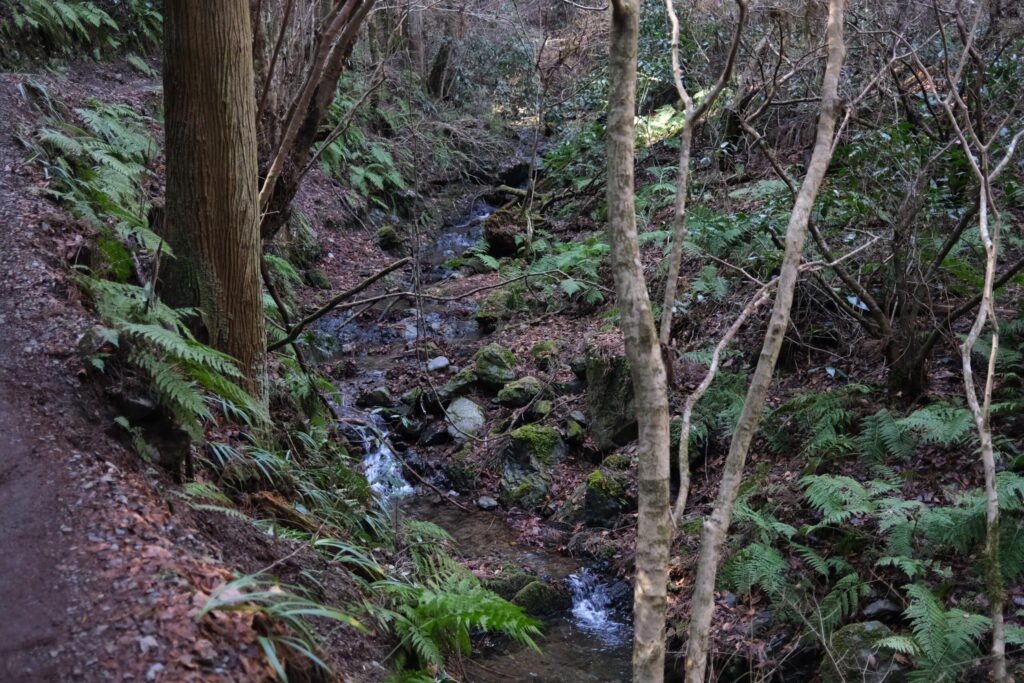
My footwear for this trip was my 3-season hiking boots, the “Montbell Alpine Cruiser 800,” which I hadn’t worn in a while. They are reliable partners I’ve shared hardships with for the past 3 years. When I arrived at Takaosanguchi Station, geared up, and started walking, I was completely shocked.
“The fit of the boots has dramatically improved… plus, they feel incredibly light!”
Throughout the winter, I had been walking in heavy, stiff winter boots with 12-point crampons. My feet had definitely grown and upgraded to a tougher, “mountain-ready” spec. Feeling as if I had wings on my feet, I naturally had a huge smile on my face as I headed toward Trail 6. The mountains really are the best.
Blissful Salt Ramen at the Summit and the Baptism of the First Jetboil Cooking
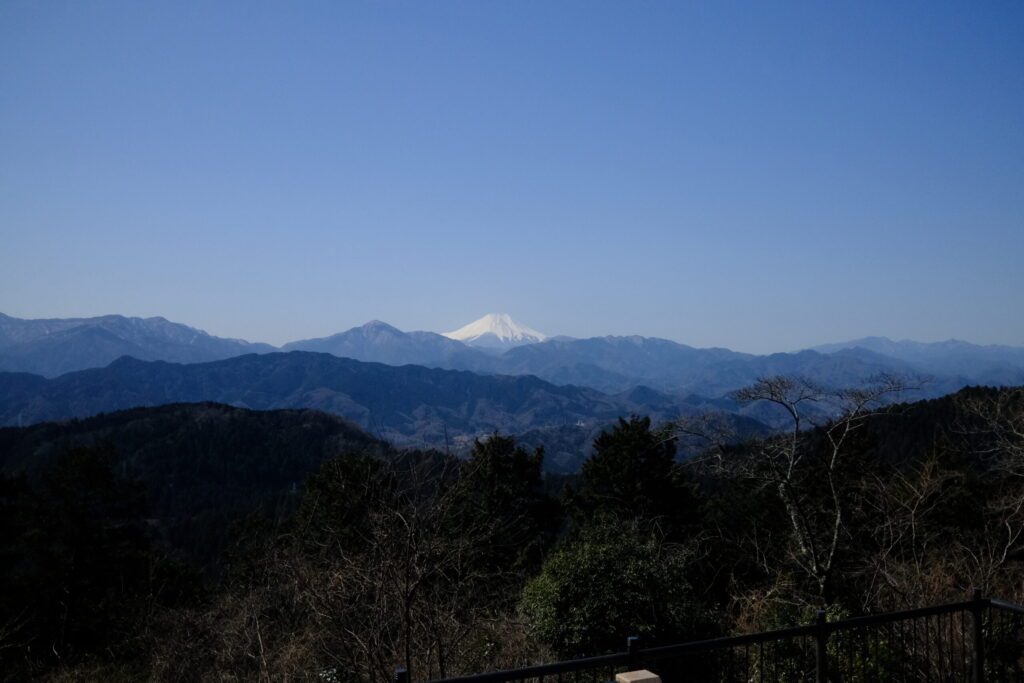
I easily conquered Trail 6 and reached the summit in a little over an hour. The summit had perfectly clear skies and was bustling with many hikers. While admiring the majestic Mt. Fuji, it was time for my highly anticipated lunch.
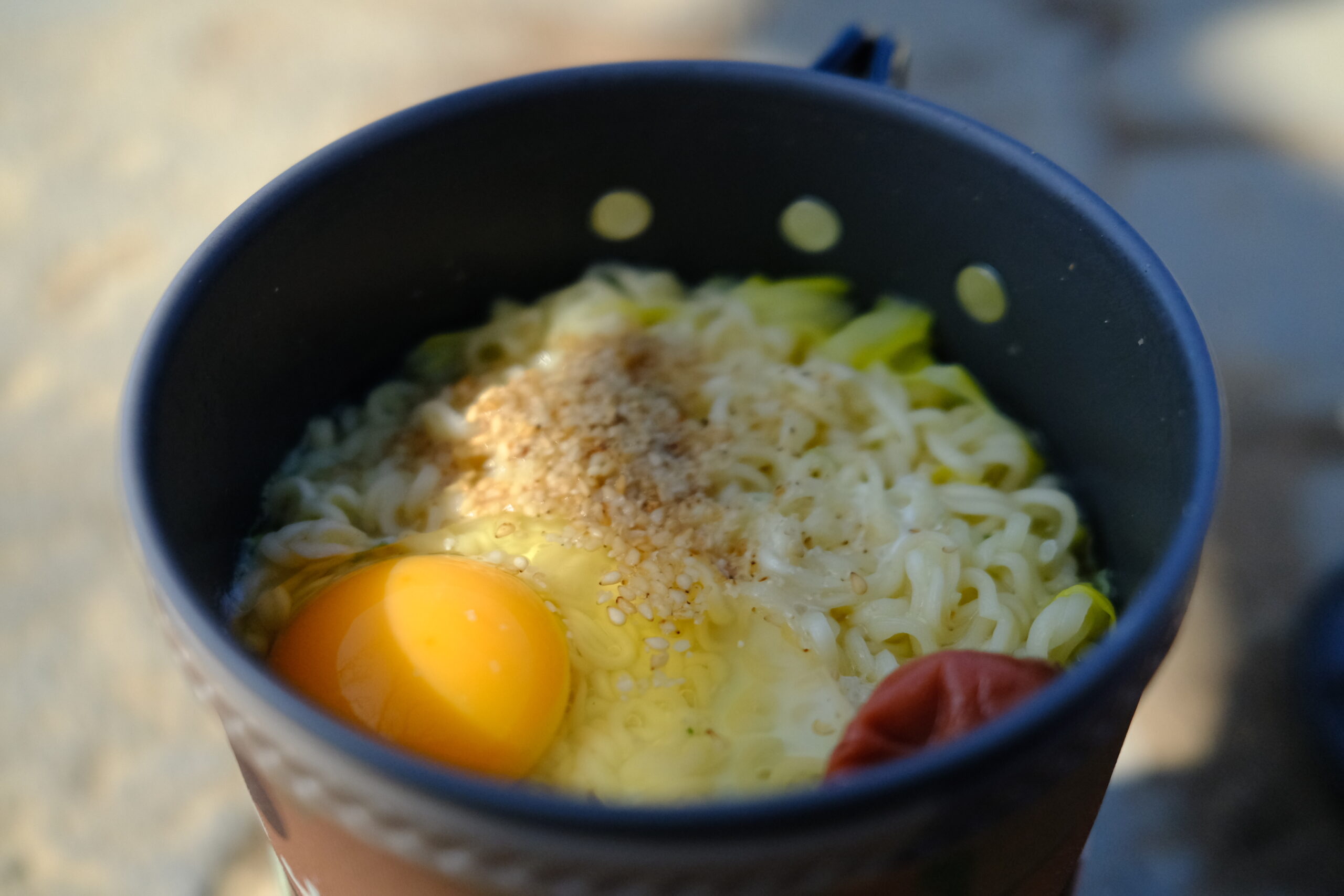
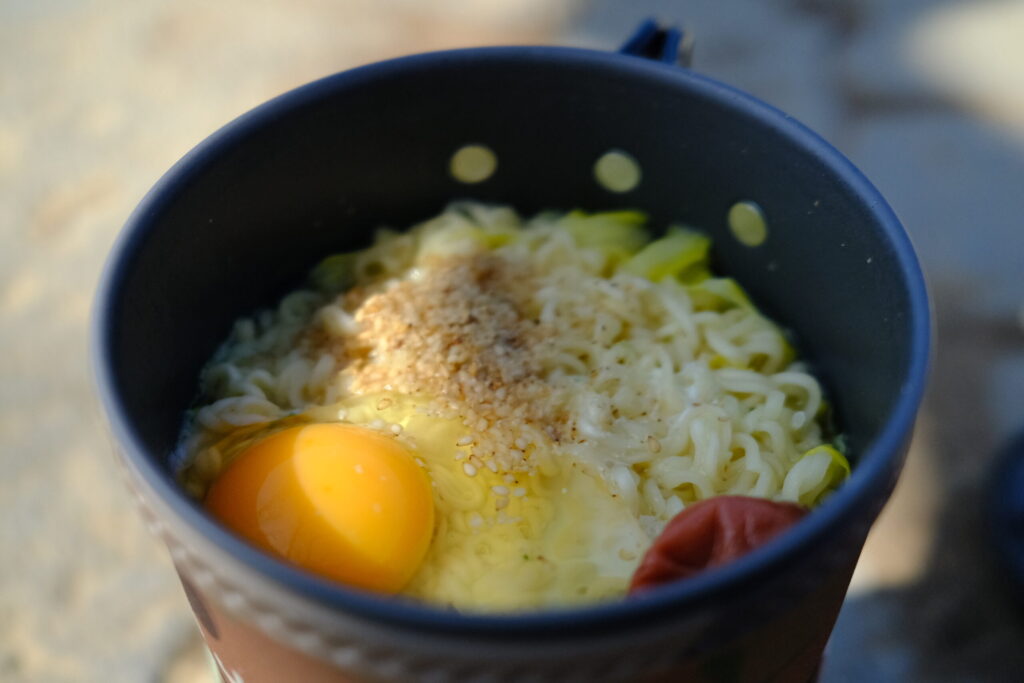
Today’s mountain meal was “Sapporo Ichiban Salt Ramen.” Since I originally planned to eat while watching plum blossoms at Mt. Ootakatori, I brought “Umeboshi” (pickled plums) as a topping. The mountain changed, but the plum theme remained.
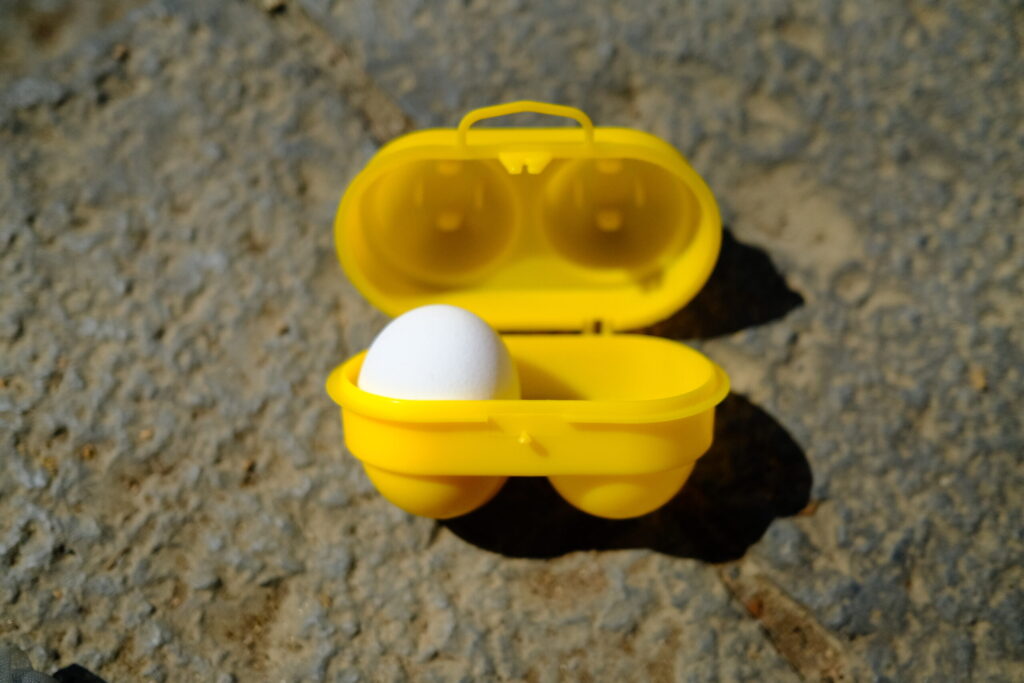
Also, I brought a “hidden new gear” on this hike… a “dedicated case to carry raw eggs without breaking them”! It protected the raw egg perfectly inside my backpack, successfully clearing the mission of bringing it to the summit intact. This was also a practical test to get used to operating my beloved Jetboil so I can boil water quickly even in harsh environments.
Hot salt ramen made with the Jetboil, topped with a raw egg and a pickled plum, all while looking at Mt. Fuji. To say the least, it was the ultimate recovery time. Another secret mission at the summit was my “first time cooking with the Jetboil.” Here are my honest thoughts and notes for future optimization.
1. The “Busyness” of Explosive Speed and the Placement Problem
I had heard the rumors, but it boils water ridiculously fast! It reaches a rolling boil the moment you put the lid on, which makes the process of adding ingredients extremely busy. A blind spot was “where to put the lid.” If you accidentally place the wet, steam-covered lid on the ground, dirt blown by the wind sticks to it… Securing a spot for the lid beforehand is a must.
2. The Cover Interference Problem
The piping hot ramen was ready. But when I tried to drink the soup directly from the pot, my mouth completely hit the neoprene insulation cover. I couldn’t help but wonder at the summit, “If soup soaks into this, how does everyone wash it every single time?”
3. After-Meal Coffee and the Trap of the “Procedure”
The ultimate blissful moment at the summit is after-meal coffee. But here, I realized a fatal mistake. You absolutely must separate the tasks: “Boil water first -> Then cook.” If you make salt ramen first and then boil water for coffee in the same container… you will definitely end up with “Salt Ramen-flavored coffee” (lol).
■ Towards Future Optimization
- An “insulated bottle” to keep boiled water hot and a “separate cup” are essential.
- You need to simulate the order of “what to boil first and how to cook” in advance.
My first Jetboil experience left me with a mountain of issues. But realizing this “completely unoptimized inconvenience” was the greatest harvest. The process of rebuilding the system for the next trip is what makes this so fun.
Courageous Retreat and Perfect Risk Management Securing an Escape Route
After finishing my blissful time at the summit, I started my descent. However, right after I started walking, that “suspicious discomfort” reappeared in my hamstrings due to the eccentric contraction (the load of muscle lengthening during descents).
Initially, I had thought about extending the hike and traversing to “Mt. Shiroyama.” But after carefully communicating with my legs during a break, I made the clear-cut decision to give up the traverse, concluding, “Let’s stop here for today.” The main purpose of this hike wasn’t to push my limits and cover distance, but strictly to “check my recovery.”
Therefore, for the descent route, instead of returning the way I came (Trail 6), I chose a less familiar path going from “Trail 4” through “Trail 2.” Partly because taking the same path is boring, but the biggest reason was that Trail 4 would allow me to “safely escape down the mountain using the cable car if my hamstrings completely gave out.”
Having such a rich variety of retreat options tailored to my legs’ condition… when I realized this fact, I could truly validate my decision-making process from the morning: “Changing my destination to Mt. Takao after the train trouble was the absolutely correct choice.”
Sudden Lifespan Declaration!? The Limits of the Summer Boots Discovered at the Washing Area and the Next Process
Communicating with my legs, the descent safely ended in about an hour. I didn’t push my hamstrings to the limit, yet I applied a pleasantly stimulating load to the muscles. It was a wonderful hike where I could perfectly check my current leg potential and recovery status under complete control.
“Yep, all my decisions today were totally spot on!”
Filled with a sense of accomplishment, I was scrubbing the mud off my boots at the washing station in front of Takaosanguchi Station. Right at that moment, the biggest shock of the day hit me.
“…Cold!?”
As I scrubbed with the brush, water slowly began to seep into the inside of the boot. My reliable partner, the Alpine Cruiser 800, which had shared grueling hikes with me for 3 years. Its waterproof function (Gore-Tex) had completely reached the end of its lifespan.
I see, so that’s what it is. This Mt. Takao trip was a hike to check my hamstrings’ recovery… and at the same time, it was a hike where the mountain gods gave me the perfect excuse to “buy brand new 3-season boots” (lol).
Accepting this worn-out reality, the process of searching for the next strongest gear begins here.
Bonus: How to Access Mt. Takao from Tokyo Station
For those visiting Japan, Mt. Takao is incredibly accessible from central Tokyo. It’s the perfect spot for a day hike! Here is the easiest and most recommended route from Tokyo Station.
The Most Recommended Route (via Shinjuku)
- Tokyo Station to Shinjuku Station: Take the JR Chuo Line (Rapid or Special Rapid). It takes about 15 minutes.
- Shinjuku Station to Takaosanguchi Station: Transfer to the Keio Line and take the Limited Express (Mt. Takao) bound for Takaosanguchi. It takes about 50 minutes.
- Total Travel Time: Approx. 1 hour and 10 minutes.
- Total Fare: Approx. 630 yen (JR 210 yen + Keio 420 yen).
Pro Tip: “Takaosanguchi Station” is the final stop on the Keio Line, so you can relax and enjoy the ride without worrying about missing your stop!

コメント